A typical Twin Cities asphalt shingle reroof costs $15k and a full house re side costs $19k, according to the Freedom Exteriors 2026 cost index, so a home that needs both should budget for two full scopes. This page covers what the combined job costs, what moves the price, which trade goes first, the code rules that apply to the roof, how hail and wind affect material choices, and how to choose who does the work.
Updated November 2026
The Freedom Exteriors 2026 cost index puts a typical Twin Cities asphalt shingle reroof at $15k, within a range of $8.2k to $23k, and a full house re side at $19k, within $10k to $29k. Adding the two typical figures means $15k plus $19k, so plan for two complete scopes rather than one project with a discount built in.
The index is localized from national baselines by each metro's local labor cost. The Twin Cities index is 1.05, Milwaukee is 0.91 and Eau Claire is 0.76, which is why the same house costs less in some markets than others.
What to do: ask for one written scope with the roof and the siding priced as separate line items, so you can see each number and decide whether to do both now or stage them.
| Metro area | Local cost index | Asphalt shingle reroof | Full house re side |
|---|---|---|---|
| Twin Cities, MN | 1.05 | $15k ($8.2k to $23k) | $19k ($10k to $29k) |
| Madison, WI | 0.95 | $15k ($7.8k to $22k) | $19k ($9.8k to $27k) |
| Milwaukee, WI | 0.91 | $14k ($7.7k to $21k) | $18k ($9.6k to $27k) |
| Eau Claire, WI | 0.76 | $13k ($7.1k to $20k) | $17k ($8.9k to $25k) |
Source: Freedom Exteriors 2026 Exterior Cost Index by Metro
Material choice moves the price more than anything else. Freedom Exteriors prices vinyl siding at $9,000 to $18,000 installed, engineered wood at $14,000 to $28,000, fiber cement at $16,000 to $38,000 and steel or metal at $18,000 to $40,000. On the roof, architectural asphalt shingle runs $8,000 to $18,000, premium or designer shingle $14,000 to $26,000, standing seam metal $20,000 to $45,000 and flat or low slope membrane $9,000 to $20,000.
The second driver is the existing roof. If it already carries two layers, a full tear off is mandatory and stripping two layers takes longer than stripping one, which adds labor.
The third driver is complexity. Every dormer, porch roof and chimney is a place where roof and wall meet and flashing has to be rebuilt. More junctions mean more labor on both jobs.
What to do: count your dormers, porch roofs and chimneys before you ask for quotes, and ask each bidder how they will flash every one of them.
| Siding type | Typical installed range |
|---|---|
| Vinyl | $9,000 to $18,000 |
| Engineered wood | $14,000 to $28,000 |
| Fiber cement | $16,000 to $38,000 |
| Steel or metal | $18,000 to $40,000 |
Source: Freedom Exteriors siding replacement guide
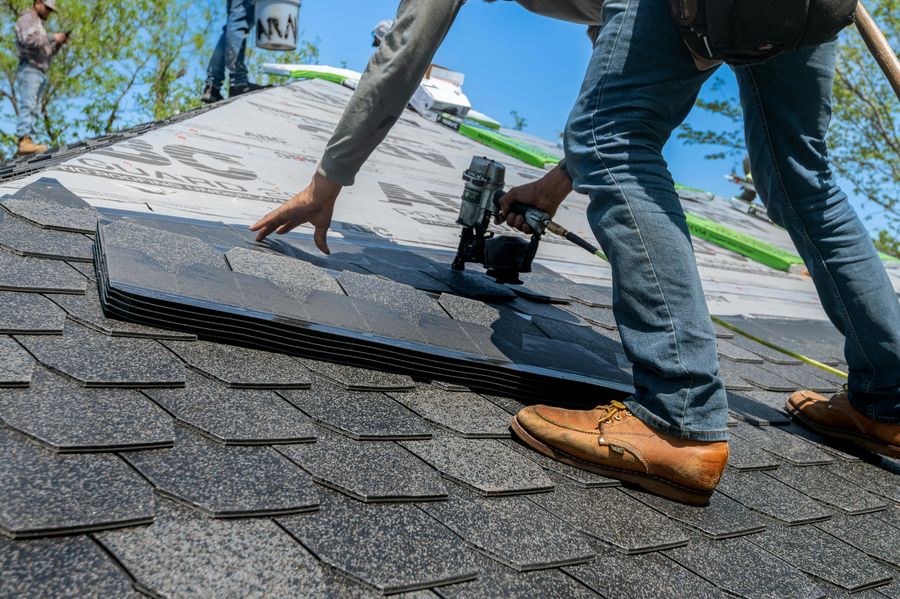
In most cases the roof goes first. Tear off sends shingles, nails and debris down the walls, and ladders and scaffolding scrape new siding. Doing the roof first protects a finished wall from that damage.
The exception is the joint itself. Where a roof meets a wall, step flashing has to tuck behind the wall's weather barrier and over the shingles below. If the roof is finished and the siding comes later, the siding crew can still lap the barrier correctly, but only if both crews work from one plan. If the two jobs are done by separate companies with no shared plan, that joint is where leaks tend to start.
Porch roofs and dormers deserve the most attention. Their walls are short, the flashing is exposed to runoff, and a gap behind the siding is hard to see until water damage shows up inside.
What to do: decide the order before work starts, put it in writing, and have the contractor name who is responsible for the flashing at each roof to wall joint. One contractor owning both jobs removes the handoff entirely.
Three rules from the International Residential Code come up most. Section R908.3 does not allow a new roof covering over a roof that already carries two layers, so a second tear off becomes mandatory. That adds time and cost, and it is worth knowing before you compare quotes, because a bid that skips the tear off may not be compliant.
Section R905.2.2 allows asphalt shingles only at 2:12 pitch and steeper, and requires double underlayment from 2:12 up to 4:12, which adds material. Many porch roofs and additions sit in that low slope range, so check them even when the main roof is steep.
The IRC also requires an ice barrier membrane from the eave edge to at least 24 inches inside the exterior wall line in regions with a history of ice dams. That membrane ties into the wall, so it is another reason roof and siding crews need a shared plan.
What to do: ask each bidder how many layers they found, what pitch the porch and dormer roofs have, and whether the quote includes the ice barrier. Local permit rules vary, so confirm with your city.
Storm history should shape the choice. NOAA Storm Events records list 105 hail events and 36 damaging wind events within 15 miles of Cottage Grove from 2020 to 2024, with stones up to 3.0 inches. The NOAA NCEI Storm Events Database logs 88 hail events within 15 miles of Hudson over the same years, and 62 of them came in 2022 alone. Near Rochester, NOAA logs 48 hail events and 53 wind events, a fairly even split between hail and wind.
Class 4 is the highest rating under the UL 2218 impact standard, earned by dropping steel balls on the roofing material to simulate severe hail. Siding takes hail hits too, so a hard material such as fiber cement ($16,000 to $38,000) or steel ($18,000 to $40,000) behaves differently from vinyl ($9,000 to $18,000) after a big storm.
What to do: ask whether the roof product you are offered carries a Class 4 rating under UL 2218, and weigh the higher price of tougher siding against how often your area sees large hail.
Not every roof that looks tired needs replacing. Freedom Exteriors lists typical completed repairs at $300 to $1,000 for a minor leak or shingle repair, $400 to $1,200 for flashing, vent or chimney seal repair, $1,000 to $6,500 for storm, wind or hail damage repair and $300 to $900 for emergency tarp and stabilization. Compare those to a $15k Twin Cities reroof.
A sound roof can let you spend on siding first. One homeowner, Sean K., described exactly that outcome after hail storms: they inspected the roof and told him he had a solid roof with no need to replace it at this time.
If the roof is near the end of its life and the siding is failing too, the logic reverses. Doing both while scaffolding is up and the walls are open avoids paying twice for access and flashing.
What to do: get the roof inspected before you decide, and ask for the inspection findings in writing, including layer count and any decking or ventilation problems.
Choose a contractor that will put both scopes, the flashing plan and the order of work on one document. Ask for proof of license and insurance, ask how many layers the roof has, and ask who is on site when the two trades meet at the dormers and chimneys. Freedom Exteriors is veteran owned, licensed and insured, and holds a 5.0 rating across 34 Google reviews. Whoever you choose, ask for those same credentials.
Then decide what else belongs in the project. Gutters are the cheapest add on: the cost index puts a full Twin Cities replacement at $2.7k ($1.2k to $4.1k), with seamless aluminum at $4 to $9 per foot and seamless steel at $9 to $15 per foot. A ten window job is $17k ($10k to $25k), and it ties into the same wall work as siding.
What to do: if windows are on your list, replace them before or with the siding, not after, so the trim and flashing are done once.
“Called Freedom to come out and take a look at my roof after a few hail storms since I've lived here. They inspected and let me know I had a solid roof. No need to replace at this time. Honesty is hard to come by these days and I appreciated…”Sean K.
A free estimate gets you exact numbers, real samples and an honest recommendation from a veteran owned local contractor.
Prefer to pick a time? Book your free inspection online